
Dog Health Testing Explained: What to Test, How It Works, Where to Get It Done
Health testing is one of those things everyone tells you to do and almost nobody explains. You're told your dog needs "the breed tests" before you breed from him, and left to work out for yourself what that means, who does it, what it costs, and what you're supposed to do with the piece of paper at the end.
Here's the whole thing in plain terms.
What testing actually gets you
The strongest argument for it isn't moral, it's arithmetic. Kennel Club and Animal Health Trust research found that ten years after a DNA test becomes available for a condition, the disease-causing mutation had dropped by 90% or more in the breeds concerned. That's not breeders being careful in a vague sense. That's a specific, measurable collapse in the number of puppies born with those conditions, achieved entirely by people swabbing dogs and using the results.
For you, individually, it does three things.
It stops you producing affected puppies. Most of the conditions with DNA tests are recessive, which means a dog needs two copies of the mutation to be affected. Two untested dogs who both happen to be carriers will produce affected puppies, on average a quarter of the litter, and you will have no idea until they start showing symptoms — sometimes years later, in other people's homes, at which point you're getting phone calls about a dog with progressive retinal atrophy going blind at five.
It widens your options rather than narrowing them. This is the part people get wrong. A carrier is not a dog you have to cull from your programme. A carrier mated to a clear dog cannot produce an affected puppy. Testing tells you which matings are safe, so a good dog who happens to carry something stays usable instead of being quietly dropped.
And it decides how visible your puppies are. Since the Assured Breeder Scheme closed at the end of 2024, the Kennel Club's Health Standard has become the benchmark, and litters on Find a Puppy are now ordered by it — litters where both parents meet the standard appear above litters where only one does, which appear above litters with partial testing. Untested parents sit at the bottom of the list. Whatever you think of that, it's now a commercial fact.
The three kinds of test
DNA tests
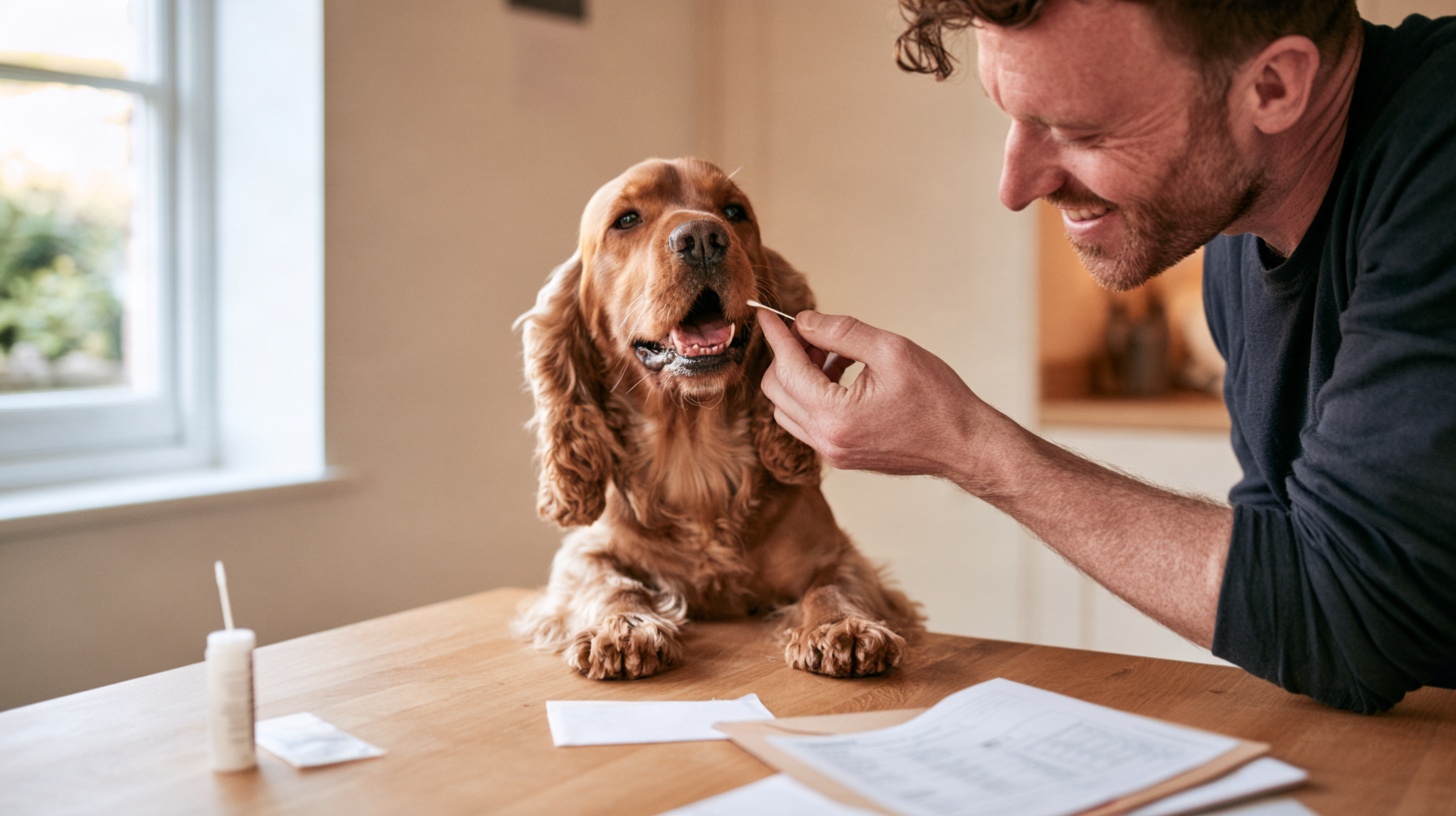
DNA tests look for a specific mutation. They're done from a cheek swab you take at home, they're one-off, and the result is absolute: clear, carrier, or affected. A clear dog stays clear for life, so this is the only category you pay for once and never revisit.
Scored and graded schemes
These cover the complex conditions that aren't down to a single gene — mainly hips and elbows. There's no clear/carrier answer here because dozens of genes and the environment are involved. Instead your dog is x-rayed, the plates go to a British Veterinary Association panel, and you get a number back. Hip scores run from 0 to 106 across both hips, with lower being better. Elbows are graded, and the standing advice is to breed only from dogs graded 0 or 1.
Clinical examinations
These are a specialist looking at your dog. Eye testing under the BVA/KC/ISDS Eye Scheme is the main one, along with gonioscopy in breeds prone to glaucoma, heart testing in breeds like the Cavalier, respiratory function grading in the flat-faced breeds, and MRI scanning where Chiari malformation and syringomyelia are a concern. These are snapshots of the dog on the day, so unlike a DNA test they need repeating while a dog is in use.
There are also two tests that aren't about inherited disease at all but belong in any breeding dog's file: a Brucella canis blood test, and a semen evaluation for a dog about to start work at stud.
The process, start to finish
Find out what your breed actually needs. Go to the Kennel Club Health Standard, or your breed's page in Breeds A to Z. The Health Standard splits tests into good practice and best practice, and it changes as the evidence changes, so check it fresh rather than relying on a list your breed's Facebook group has been circulating since 2019.
Check the laboratory before you order. The Kennel Club only records results from laboratories on its accepted list. Results from anywhere else will not appear on your dog's record — you'll have paid for a certificate that no bitch owner can verify. It's also a requirement that the dog's microchip or tattoo number appears on the certificate alongside the registered name or number, so a result that doesn't identify the dog properly is worth nothing either.
Order the kit and take the swab. Most labs post swabs out free. It's a cheek swab, done at home, no vet needed, and the main failure is doing it after the dog has eaten or drunk — leave an hour, rub firmly inside the cheek, air-dry, post it back. Turnaround is usually one to four weeks.
Results get recorded. With the Kennel Club's own service and several of the approved labs, results go onto the dog's record automatically and appear on the Health Test Results Finder. With others you scan and email the certificate to the Kennel Club yourself. Worth knowing which you're dealing with before you order.
For the x-ray and clinical schemes the process is different. Your dog must be at least 12 months old for hip and elbow scoring, permanently identified by microchip or tattoo, and you need his registration paperwork available so the details can be printed onto the radiographs. Your own vet takes the plates under sedation or anaesthetic and submits them; the BVA panel scores them and the result is published. Eye testing is booked directly with a BVA-appointed eye panellist, either at their practice or at one of the eye testing clinics run around the country.
Where to get it done
Provider | What they do | Rough cost |
|---|---|---|
Kennel Club DNA Testing Services (run with Weatherbys) | Breed-specific packages, one swab covering all of the breed's priority tests, results recorded automatically | Packages from around £50 up to £135 depending on breed |
Laboklin (UK), Manchester | Individual tests and breed bundles, free swab kits, widely used by UK breed clubs | Breed bundles typically £130–£150 |
Canine Genetic Testing, Cambridge | Individual tests and breed bundles, UK-based | Individual tests around £50–£66, bundles around £99 |
Animal DNA Diagnostics (UK) | Individual DNA tests | Varies |
Embark (USA), Wisdom Panel / MyDogDNA | Broad panels covering many conditions at once, plus ancestry and traits | Varies |
All of those are on the Kennel Club's accepted list, but that list does change, so check it on the day you order rather than taking this table's word for it.
Two ways to spend less. Most breed clubs negotiate discount codes with a laboratory for their members, usually via the Breed Health Coordinator, and it's often a substantial saving on a bundle. And hip scoring, eye testing and heart testing are frequently run as discounted clinics at championship shows and breed club open days, which also puts you in front of people who do it constantly rather than a general practice that scores two dogs a year. For x-rays especially, that matters — positioning is everything, and a badly positioned plate can cost your dog points he doesn't deserve.
On the clinical side, the BVA publishes a list of appointed eye panellists and the dates of eye testing clinics, which is the right starting point rather than asking your own vet, who probably isn't one.
What you're looking at overall
For most breeds, a DNA package at £50 to £150, hips and elbows at £250 to £350 all in once you include your vet's charges, and an eye test at around £72 with the BVA's own submission fees on top for the scheme work. Call it £400 to £600 for a dog needing the full set, most of it one-off and paid once in the dog's life.
Set that against the cost of finding out the hard way — a litter of puppies with a condition you could have tested for, refunds, vet bills you feel obliged to contribute to, and a reputation that takes years to rebuild in a small breed community.
General guidance for breeders, not a substitute for veterinary advice. Test requirements and laboratory lists change; always check your breed's current entry in the Kennel Club Health Standard before booking.
Related guides
Should You Turn Breeders Away? Even on the Day of a Mating?
Would you refuse a stud mating on the day? From a girl arriving covered in fleas to a stud being twice the expected size, I share why sometimes saying no is the most responsible decision.
Should You Offer a Mobile Stud Service? The Pros and Cons
Going mobile widened my reach more than anything else I have done. It has also had me in London at rush hour twice in the same day. Both sides of it, honestly.
Questions to Ask a Stud Owner Before You Book
I am on the other end of these calls most weeks. Here are the questions worth asking, what you are really asking for, and what a good answer sounds like.
Comments (0)